





“When the wind blows, build windmills, not walls.”
This Chinese proverb captures the spirit of Jio Platforms’ journey. Its rise from a new entrant in telecom to one of India’s most valuable listed companies is a case study in identifying an opportunity, challenging an established market and scaling rapidly.

It took Reliance Industries decades to build a business valued at around Rs 16 lakh crore. Jio Platforms, meanwhile, reached a market capitalisation of more than Rs 13 lakh crore in barely a decade. Following its stock market debut on October 28, Jio became India’s second most valuable listed company after its parent, with a market value of approximately $137 billion at the close of its first trading day. This is a remarkable milestone for India Inc, but its significance extends beyond the valuation.

Jio changed the economics of connectivity, accelerated data consumption and forced the telecom industry to rethink its business models. In doing so, it helped make digital access an essential part of everyday life. For earlier generations, access to education often depended on physical infrastructure, electricity and books. Millennials and younger Indians have their own stories of walking miles to find network connectivity or free Wi-Fi. Affordable data has widened access to education, employment, entrepreneurship and financial services, even as affordability and service quality remain important concerns.The larger question is whether Jio can build on this achievement to become a technology company with globally relevant products and services.
From connectivity to technology
Jio is a potential proxy for investors seeking exposure to India’s digital infrastructure and artificial intelligence ambitions. Its investments in data centres, cloud infrastructure and digital services could help it benefit from rising AI adoption. But the challenge is to translate these investments into meaningful revenue, profits and sustainable returns.

The distinction between traditional businesses and new-age technology companies is becoming increasingly important. Traditional businesses typically build value through physical assets, manufacturing capacity, distribution networks and established cash flows. Technology platforms can create value through networks, data and the ability to serve millions of customers without costs rising proportionately with revenue.
Jio has demonstrated that it can build a platform at extraordinary scale. Its entry into telecom established cost leadership as a powerful competitive strategy, expanded data consumption and accelerated the adoption of digital services. But low prices are not an end in themselves. Maintaining affordability while generating adequate returns will require continued investment in network upgrades, capacity and new technologies.

The ambition also extends beyond telecom. Elon Musk’s businesses illustrate how entrepreneurs can combine technology, infrastructure and products across conventional industry boundaries. Jio’s opportunity is to pursue a similarly expansive vision, although its business model and competitive environment are different. The test will be whether it can turn its reach and infrastructure into differentiated offerings that customers are willing to pay for.
A global comparison
India has produced globally competitive businesses in several sectors, but it has relatively few technology platforms with the international reach of companies such as Nvidia, Apple and Samsung. TCS and Infosys have established global leadership in technology services. Building globally dominant product and platform businesses, however, remains a different challenge.
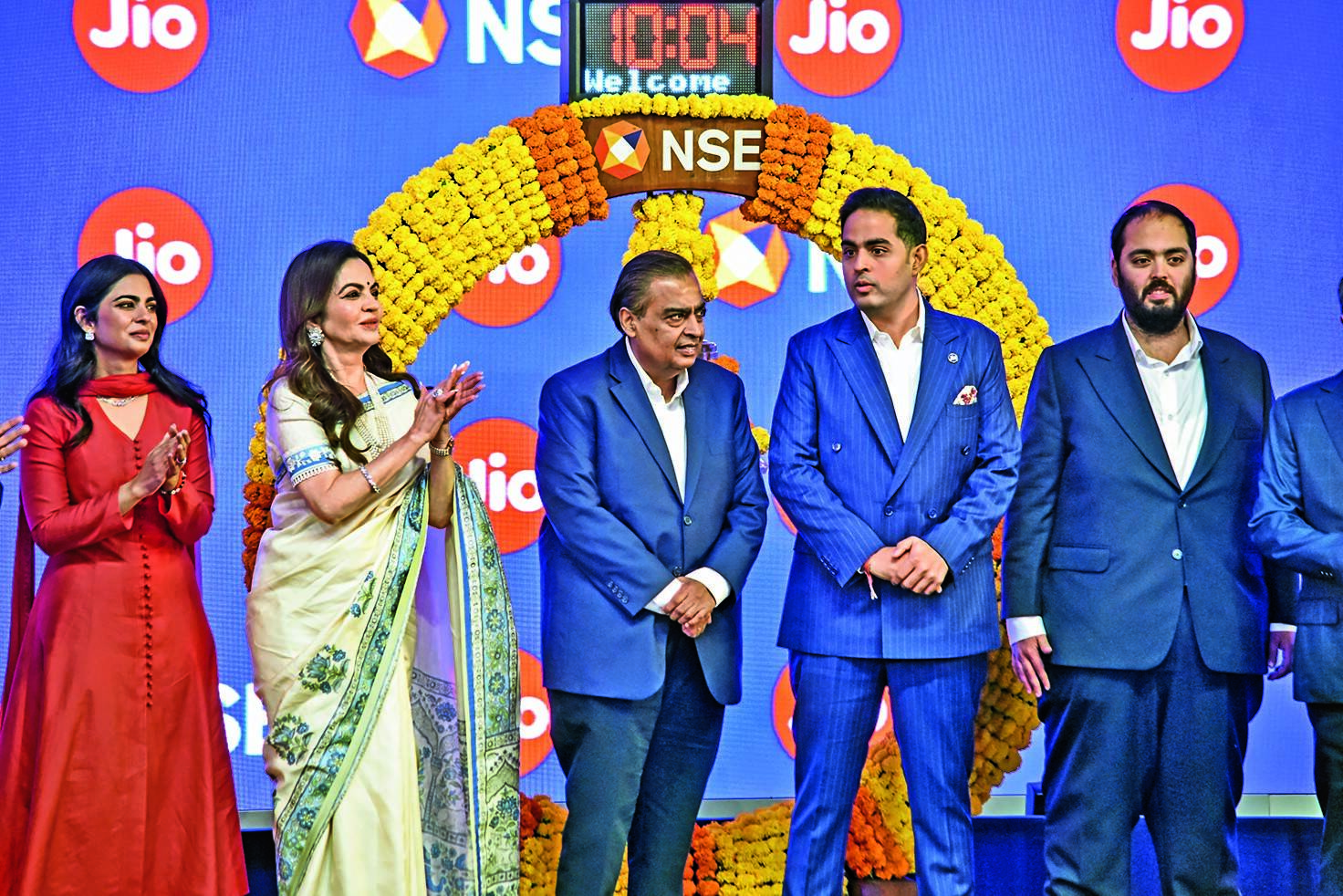
Jio’s market capitalisation of about $137 billion at the close of its debut placed it among the world’s five largest telecom companies by market value. Its investments from global technology companies such as Meta and Google also indicate international investor interest in its potential.
Comparisons with Meta, Alibaba and SpaceX reflect Jio’s technological ambition, even though their business models differ considerably. The distinction between a services company and a technology platform matters here. India’s IT services companies have built global businesses by providing technology expertise and solutions. Jio’s ambition is to operate digital infrastructure and platforms serving hundreds of millions of users, while expanding into cloud, AI and other digital services.
Yet scale alone does not make a company a global technology leader. Its valuation must ultimately be supported by earnings, cash generation, growth opportunities and a defensible competitive position. The real test is whether Jio can evolve from a large domestic digital infrastructure provider into a technology business whose products and services find markets beyond India.
The wider digital ecosystem
Jio’s impact also extends beyond its own business. Affordable connectivity has helped create opportunities for startups and micro, small and medium enterprises. Small businesses can reach customers online, accept digital payments, advertise through digital channels and use cloud-based tools. Startups can test business models and expand without building extensive physical distribution networks.
This multiplier effect is an important part of India’s digital transformation. Connectivity has become an economic enabler, allowing businesses to reach customers and participate in markets that were previously difficult to access. The opportunity now is to move from enabling digital activity to capturing more value from it.
Jio’s next phase of growth will therefore depend on creating revenue streams beyond connectivity. Data centres, enterprise solutions, cloud services, digital applications and AI-related offerings provide avenues for expansion. But these are competitive markets requiring substantial investment, technological capability and sustained execution. Jio must demonstrate that these businesses can generate meaningful revenue and profits rather than remain extensions of its telecom operations.
Building for the future
The listing also brought the Ambani family’s succession plans into focus. The family’s public appearance, including the prominent presence of Mukesh Ambani’s grandchildren, offered a glimpse of how the next generation is being introduced to the group’s ambitions.
At a time when many established promoters are concentrating on wealth preservation and family offices, the Ambanis continue to make large bets on new businesses and technologies. There is a broader lesson for India Inc: succession is not merely about transferring ownership. It is about preparing businesses for changing industries, investing in new capabilities and empowering the next generation to take risks.
The family’s reputation, combined with Jio’s record of growth and its future ambitions, helped attract strong investor interest in the IPO. The offering was fully subscribed within about 100 minutes and ultimately received bids for 22.19 times the shares on offer, raising around Rs 30,213 crore.

The response reflects investor appetite for a technology business that has transformed India’s digital landscape. But the IPO also changes the nature of accountability. Jio will no longer have to focus only on customers, a familiar challenge for a consumer-facing business. It must now meet the expectations of a much wider group of public shareholders.
Investors will look for capital appreciation, dividends where appropriate, transparent disclosures and predictable financial performance. They will also expect evidence that investments in emerging businesses can generate adequate returns. Jio must reconcile its long-term technology ambitions with the discipline and accountability demanded by public markets.
Please share your feedback, suggestions if any. You can reach me on amol.dethe@timesinternet.in.
(Editor’s note is a column written by Amol Dethe, Editor, ETCFO. Click here to read more of his articles exploring several buzzing topics)