




India’s fast-moving consumer goods (FMCG) sector saw a deceleration in volume growth in the July-September quarter, with slower expansion of rural demand and rising costs putting smaller regional manufacturers under greater pressure, even as large listed companies reported stronger growth.
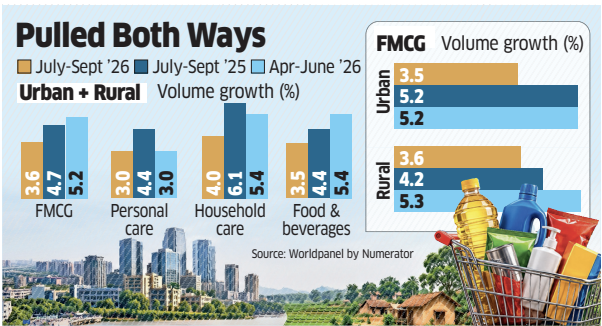
FMCG sales volume increased 3.6% during the quarter, down from 4.7% a year earlier, according to Worldpanel by Numerator. In contrast, listed companies reported strong growth. Hindustan Unilever posted 7% underlying volume growth, Marico’s India business expanded 10%, Godrej Consumer Products reported an 8% year-on-year increase, while Nestle India recorded double-digit volume growth.
Also read: Dabur Global CEO Malhotra Resigns, as leadership churn in legacy FMCG companies continues
The divergence suggests that growth at larger companies is not necessarily translating into a broad-based recovery in consumption, with organised players potentially gaining share as smaller and regional competitors struggle with costs, supply constraints and weaker demand. “Smaller players appear to be losing ground to larger organised companies across most categories,” said Mayank Shah, vice president at Parle Products.
The pressure could be particularly pronounced in rural markets, where a large part of the smaller, local FMCG industry operates and where consumption growth has also moderated. Unlike large companies with national distribution networks and stronger procurement capabilities, regional manufacturers often have less room to absorb cost increases or withstand disruptions.
Inflationary Pressures
“Smaller manufacturers had also cleared nearly two months’ worth of inventory within weeks of last year’s GST announcement, anticipating difficulties in managing the transition,” Shah said. This created a high base for comparison, while larger companies had greater capacity to manage the change.
Worldpanel tracks household purchases across branded and unbranded products, including loose items, providing a broader view of consumption than the sales reported by listed companies. Moreover, food, which accounts for nearly two-thirds of the volume tracked by Worldpanel, is commoditised and dominated by regional brands, local manufacturers and unbranded products.
Marico managing director Saugata Gupta said inflation and supply-chain disruptions were creating an advantage for larger companies, squeezing smaller and regional competitors.
“Usually, in tough times, it is the smaller players, regional players who get squeezed and the larger players controlling it,” Gupta said during the company’s earnings call.
Shortages of stocks, packaging materials and commercial gas had affected smaller competitors more, while Marico benefited from its procurement capabilities and a relatively muted competitive environment, he said.
The rural slowdown adds to the challenge for these manufacturers. Rural FMCG volume increased 3.6% in the September quarter, marginally ahead of urban growth of 3.5%, but both were significantly lower than a year earlier. Urban growth was 5.2% in the year-ago quarter, while rural growth was 4.2%.
Manoj Menon, director-commercial at Worldpanel Division, said the current 12-month rolling FMCG volume growth of 4.7% remained above the 4.1% recorded a year earlier, but could slip below last year’s level in the next quarter.
“Rural FMCG volume growth marginally outpaced urban growth in the September quarter, but urban markets continued to lead on a 12-month basis. This could reverse in the next quarter, although a rainfall deficit remains a risk to rural demand,” Menon said.
Category-level data also points to a broad-based moderation. Volume growth for personal care slowed to 3% from 4.4% a year earlier, household care cooled to 4% from 6.1%, while food and beverages decelerated to 3.5% from 4.4%.
Also read: Reliance Consumer expands Independence biscuit portfolio with nine variants
The slowdown comes amid mounting pressure on household budgets from increasing inflation. Retail inflation rose to 5.5% in September, while food inflation climbed to 7.7%. Erratic rainfall affected kharif production, adding to food price pressures and threatening rural purchasing power.
“The question is of wages, and really what happens to rural wages. The MSP has been taken up by 5% to 6% by the government, so that’s a very good move. The other is we are seeing a higher (Viksit Bharat-Guarantee for Rozgar and Ajeevika Mission-Gramin) outlay, so there will be a cushioning of rural wages in the pockets that, you know, are a challenge,” HUL MD Priya Nair said last week.